The Set Theory Guide for Artists: Chapter 4: PART 1
Large Cardinals

In this chapter, we will see a top 10 list of large cardinals. We have met several large cardinals so far. We saw in chapter 3 that we cannot prove that large cardinals exist, nor can we prove that they are consistent relative to ZFC. Large cardinals notions are really axioms, and we can choose to believe in them. Of course, there are consequences of our beliefs. For example, if there is a measurable cardinal then V ≠ L (Scott’s theorem). This chapter will include the definitions of the large cardinals on the list, reflections on a papers written about the large cardinals, and further research. The criteria for the top 10 list are:
1) It is a large cardinal. For me κ is a large cardinal if it is worldly or more. That is, if
2) Simple to state the definition (sorry Woodin cardinals).
3) Not known to be inconsistent with ZFC (sorry Reinhardt cardinals).
4) Has an interesting paper about the large cardinal (I’m sure every large cardinal has this property).
These top 10 large cardinals would be considered wildly popular among set theorists, but there is probably a wide variety of opinions about large cardinals. The order of the list itself is somewhat arbitrary and somewhat intuitive.
For each large cardinal, there are 4 parts of the presentation. First, the definition of the large cardinal from Cantor’s attic (and perhaps Jech or Kanamori). Second, will be a reflection on the paper concerning the large cardinal, including the definition of the large cardinal in the paper. Third, will be the “philosophy” of the large cardinal - the word philosophy here is very loose - it will be an artistic impression of the bird that captures the essence of the bird and the bird’s own philosophy of the world based on its perspective. Fourth, will be ideas for further research that is connected to my own research and the theme of the book. The theme of the book which will come to fruition in the last chapter, chapter 7, is to demonstrate the almost one-to-one correspondence between the degrees of large cardinals and the forcings which gently destroy them.
They are grouped into parts, but I will post them one at a time. The painting for chapter 3 is still in progress, so hang tight for the ending of chapter 3 to come.
CHAPTER 4: THE TOP 10 LARGE CARDINALS
PART 1: LARGE CARDINALS 10, 9, AND 8
PART 2: LARGE CARDINALS 7, 6, AND 5
PART 3: LARGE CARDINALS 4, 3, 2, AND 1
PART 4: THE LARGE CARDINAL CHAPTER PAINTING
PART 1: LARGE CARDINALS 10, 9, AND 8



EXTENDIBLE CARDINALS

A cardinal κ is 1-extendible if and only if there is a nontrivial elementary embedding
\(j:V_{\kappa +1} \to V_{j(\kappa) + 1}\)with critical point κ. In general, a cardinal κ is α-extendible if and only if there is a nontrivial elementary embedding
\(j:V_{\kappa + \alpha} \to V_{j(\kappa) + j(\alpha)}\)with critical point κ.
So that κ is extendible if and only if κ is α-extendible for every ordinal α ≥ 1.
(based on Cantor’s attic definition)
It is the summer of 1967. You decide you will pack one more pair of shorts. For the next month you’ll be at the
PROCEEDINGS OF THE SYMPOSIUM IN PURE MATHEMATICS OF THE AMERICAN MATHEMATICAL SOCIETY
at UCLA from July 10 - August 5. Extendible cardinals are about to drop. Ya dig?
REMARKS ON REFLECTION PRINCIPLES, LARGE CARDINALS, AND ELEMENTARY EMBEDDINGS
W. N. REINHARDT
Reinhardt’s main justification for extendible cardinals comes from the “naive reflection principle:”
Naive Reflection Principle: If Ω has any property P then there is an ordinal κ < Ω which also has property P.
It is “naive” because this reflection principle won’t hold if we consider the property
Definition 3.1: Let κ, λ be ordinals. We write E(κ;λ), and say that κ is first-order extendible to λ, in case
\((R_{\kappa}, \in) \prec (R_{\lambda}, \in) \ \& \ \kappa < \lambda. \)
Reinhardt uses
In the footnote of the title, Reinhardt says that he wrote this while visiting the University of Amsterdam and is indebted to Löb for “discussions concerning the problem of existence in mathematics.” He also thanks Gödel for discussions, but mentions that Gödel is not satisfied with the concept. Instead of reflecting on Ω, “the transfinite sequence of ordinals” which we also call ORD, and “which Cantor conceived as ‘absolutely infinite,’” Gödel was suggesting to reflect on the notion of “structural property” itself “which would then lead to the refection principles in the form ‘any structural property of the concept of set is reflected by some set.’” Reinhardt also mentions that Gödel does find the concept of extendible cardinal to be natural since sometimes smaller large cardinals “suggest the existence” of greater large cardinals the way “ω suggests the existence of a strongly compact cardinal.” We have seen ω suggest the existence of other large cardinals such as inaccessible cardinals. Reinhardt wishes to introduce a new large cardinal property in this paper: the extendible cardinal.
In trying to understand how reflection works, Reinhardt asks us to “imagine for moment that we could get outside of Cantor’s universe
and think of (‘reflect on’) V as if it were a set.” He accepts that it might go against our intuition about Ω, that if it is all of the ordinals then what is Ω+1? However, we actually need to have a syntactic expression for the order type of ORD, as it turns out. In my research, we see that in order to express symbolically the many degrees of inaccessible cardinals and Mahlo cardinals, we need Ω. Reinhardt actually perfectly explains the need to use Ω to express the degrees of a large cardinal, since the idea is that we relativize to the level of κ when defining its large cardinal degrees:
Let us suppose that κ < Ω is going to reflect Ω. Then sets correspond to elements of
\(R_{\kappa}\)and proper classes to subsets of
\(R_{\kappa}.\)
More on using Ω to express the degrees of large cardinals later. Reinhardt offers that one could think of everything as in the realm of sets and “to regard all talk of Ω as actually about an ordinal κ which reflects Ω to a suitable degree.”
There is an important theorem about extendible cardinals and supercompact cardinals:
Theorem 7.3: If κ is extendible then κ is supercompact.
Reinhardt defines κ to be supercompact “in case every set has an irreducible cover of degree κ.”
The last section of the paper is an “appraisal.”
We have tried to indicate that Cantor’s Ω is extendible. It is difficult to describe the epistemological force of this indication…
When it is an axiom that is in your heart how do you prove your love? Reinhardt argues that our experience with ZF is as much in the ideas and intuition as it is in the “formal manipulations we make using the theory.” And thus he has attempted to provide more than just the mathematical concepts. Reinhardt admits that an informal procedure “may miss its mark. But the potential gain seems worth the risk; we must always remember that the incompleteness theorems show that large cardinal considerations have a bearing even on arithmetical problems.”
The philosophy of extendible cardinals:
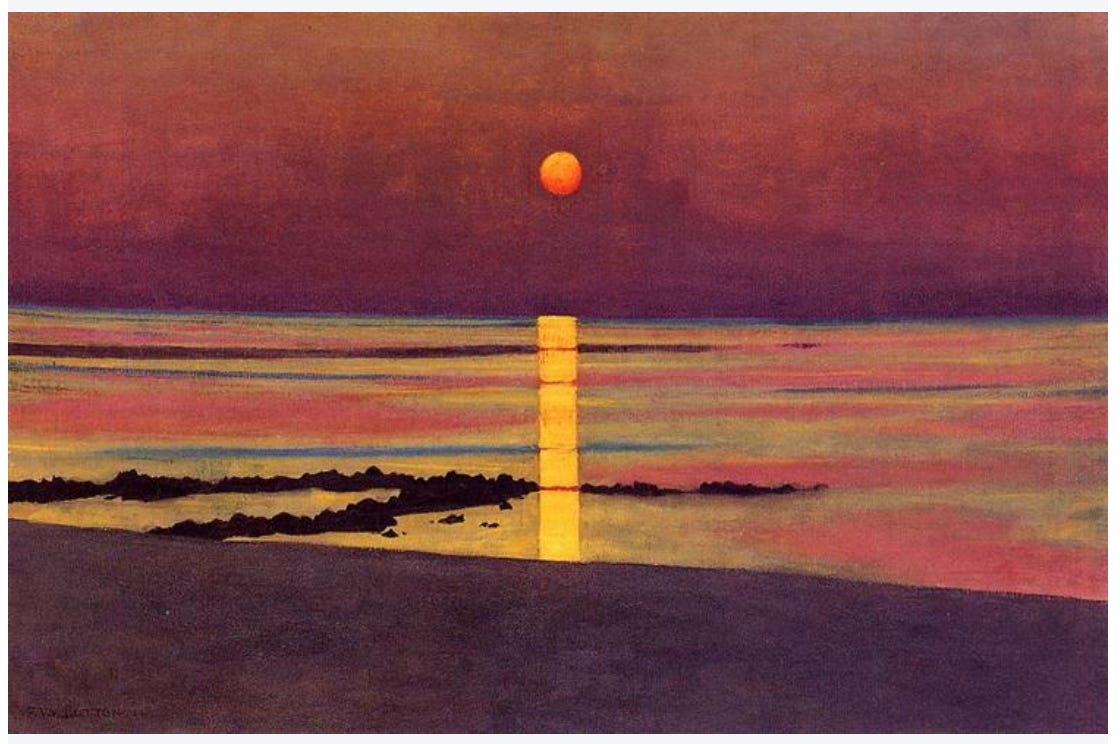
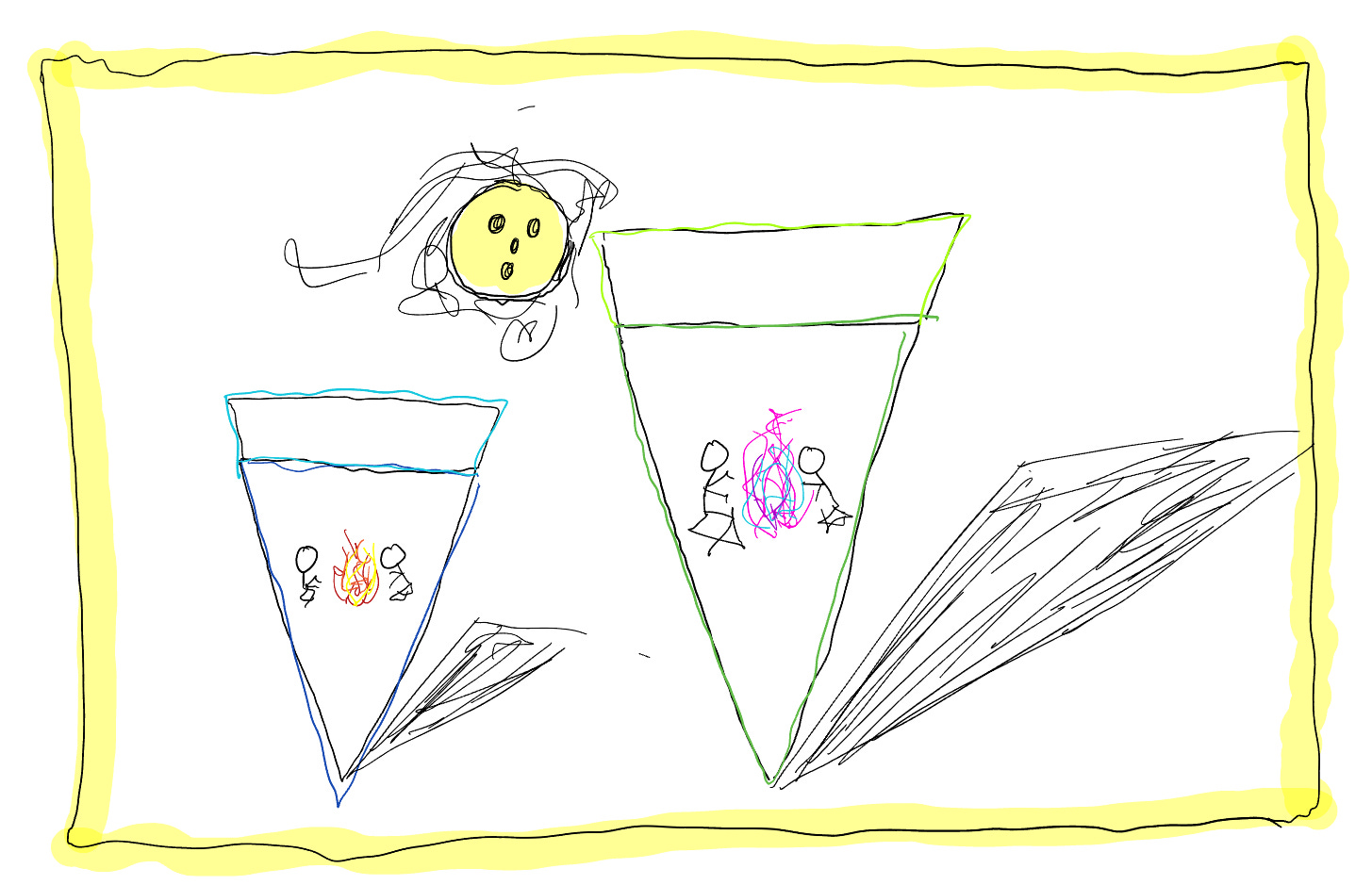
There once was a tree that was afraid of the night. “I don’t like it when the sun leaves.” The other trees felt the tremble of fear and sent back waves of encouragement. The trees told the little tree that the sun is not gone; we are just turned away. “Look at the moon tonight. So bright. The moon is bright because the sun is there shining brightly.” The little tree understood. “The moon points to the sun. If I only saw the moon I would still know there is a sun.” The tree felt happy to see the sun at night. The tree started to think about the whole world and the land of the gods just above. Was there another world like this one, with their own layer of gods, but even more radiant? The little tree looked at the moon and thought of heaven.
FURTHER RESEARCH:
Extendible cardinals have haunted my days and nights for many years, and I hope to understand them one day. A main interest is the targets of extendible cardinals - which I like to call abiding cardinals. A cardinal κ is an abiding cardinal if there is an η < κ such that η is extendible with target κ. One might like to consider degrees of abiding cardinals by counting the number of extendible cardinals of which it is a target. However, for the abiding cardinals if you are a little abiding then you are a lot abiding. A few years ago, I had a conversation on twitter with Joel David Hamkins about abiding cardinals. Here is an observation and Joel’s proof outline from that discussion. Let us say that κ is fully abiding (perhaps Ω-abiding) for 1-extendible cardinals if it is the target of κ many 1-extendible cardinals.
OBSERVATION: If κ is 2-extendible with target λ, then both κ and λ are fully abiding for 1-extendible cardinals.
PROOF OUTLINE: If κ is 2-extendible to λ, then there exists
with critical point κ. Then
can see
and so thinks that κ is 1-extendible with target λ. By elementarity λ = j(κ), and so by reflection, there is some δ < κ that is 1-extendible with target κ. And in fact there are κ many δ like this so that κ is fully abiding for 1-extendible cardinals. By elementarity, j(κ) = λ must also be fully abiding for 1-extendible cardinals. ◼

REFERENCES:
W.N. Reinhardt, Remarks on reflection principles, large cardinals, and elementary embeddings, Proceedings of Symposia in Pure Mathematics, Volume 13, Part II, 1974. Held at UCLA July 10-August 5, 1967.
Jech 2003 Set Theory. The Third Millennium Edition, revised and expanded.
Cantor’s Attic: https://neugierde.github.io/cantors-attic/Extendible
Twitter conversation about extendible cardinals with Joel David Hamkins: https://x.com/uncountableart/status/1538982977920815105
If you are interested in Woodin, Reinhardt, and Berkeley cardinals, check out Dan Hathaway’s book The Set Theory of Universally Baire Sets of Reals Before Woodin Cardinals: An Introduction. There is a chapter on large cardinals and I was also inspired by his presentation of large cardinals: http://danthemanhathaway.com/ProfLife/Books/ub_book.html
Philip Welch’s paper is also connected to this topic. It seems like he is taking more of the Gödel approach to reflecting on the concept of structural property, and there are also connections to Woodin cardinals. (2017). Global reflection principles. In Logic, methodology and philosophy of science: proceedings of the fifteenth international congress College Publications. http://www.collegepublications.co.uk/lmps/?00016